

What is Landed Cost and Why It Matters in Business In this article What Is Landed Cost? How to...
.png?width=487&height=609&name=Accounting%20Matters%20(EBITDA).png)
TL;DR: Most Amazon brands expense FBA inbound fees as operating costs. That pushes EBITDA down and keeps inventory understated—bad news for lending and exits. If you capitalize eligible inbound fees into landed cost instead, your unit economics are truer, your EBITDA is higher, and buyers are willing to pay more for the same business.
In this article
What exactly are “FBA inbound fees”?
For a typical Amazon brand, inbound FBA fees include things like:
-
Partnered-carrier shipping from 3PL or prep center to FBA
-
Inbound placement or “distributed inventory” fees
-
AWD receiving, transfer, and intake charges
-
Cross-dock or prep-center handling that exists purely to get units into FBA/AWD
These are directly tied to making inventory available for sale.
Yet in most books they land here:
“Shipping and fulfillment expense”
or
“Warehouse and logistics expense”
That means they hit the P&L immediately instead of being capitalized into inventory and expensed gradually through COGS as you sell the units.
Two ways to treat the same fees
Let’s simplify and compare two policies for the same 100,000 of inbound FBA fees.
1. Expensing inbound fees (what most sellers do)
-
100,000 goes straight into expenses
-
EBITDA is 100,000 lower
-
Inventory stays at product cost only
-
Your “true cost per unit” is invisible in the system
2. Capitalizing inbound fees into inventory
-
100,000 is added to inventory as part of landed cost
-
It flows into COGS over time, as units sell
-
EBITDA this year is higher by up to 100,000
-
Inventory is valued closer to what you actually paid
Same cash out the door. Same trucks, same pallets, same boxes.
Completely different story in your financials.
How this hits your exit valuation
Buyers and lenders rarely build models from raw transactions. They look at shorthand metrics like:
Enterprise Value ≈ EBITDA × Multiple
(plus/minus working capital and inventory adjustments)
If inbound FBA fees are expensed instead of capitalized:
-
EBITDA looks lower than it should be
-
Inventory looks lighter than it truly is
-
Total enterprise value is suppressed on both axes
In contrast, a clean capitalization policy gives you:
-
Higher, cleaner EBITDA
Because direct inbound costs are sitting in inventory and leaving the P&L only when you sell units. -
Higher (and more defensible) inventory value
Your balance sheet reflects the full cost to land the goods, not just factory invoices. -
Fewer valuation haircuts
During quality of earnings, buyers do not “discover” that you were over-expensing direct inventory costs. The uplift is already baked into your numbers, and supported by a clear policy.
For a business trading at, say, a 4× multiple, every extra 100,000 of properly reported EBITDA can translate into roughly 400,000 of additional sale price—before even counting the inventory step-up.
“Is this aggressive?” No—if you follow the rules
This is not about inventing profit. It is about applying basic inventory accounting correctly.
The guiding principle is simple:
If a cost is necessary to bring inventory to its present location and condition for sale, it can usually be capitalized.
Inbound FBA and AWD fees that move stock from your supplier or 3PL into sellable Amazon inventory meet that test far more often than not.
What should stay as expenses?
-
General warehouse overhead not tied to specific inventory
-
Customer service, marketing, and admin
-
Last-mile delivery to end customers (if treated as selling cost in your policy)
You should always align details with your CPA, but conceptually this is standard practice in well-run retail and CPG businesses.
Implementation: from theory to working policy
If you decide to capitalize inbound FBA fees, you need three ingredients.
1. A written capitalization policy
Define, in plain language:
-
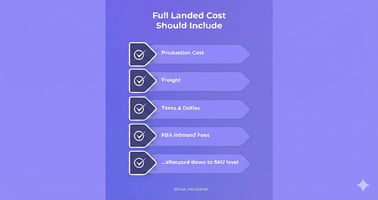
Which fee types you will capitalize (e.g., FBA inbound placement, AWD receiving, Amazon-partnered freight, prep center intake specific to FBA shipments)
-
Which you will continue to expense
-
How you will allocate inbound fees to units (by units, weight, volume, or value)
This turns a one-off decision into a repeatable rule set.
2. Clean mapping of FBA fees
You need to separate inbound-related codes from:
-
Referral and selling fees
-
Storage and long-term storage
-
Return processing
-
Customer-facing shipping charges
Once mapped, inbound codes should flow into a “Landed Cost – Inbound Fees” bucket instead of straight into expenses.
3. Automation for allocation and posting
Without automation, capitalizing inbound fees quickly becomes a spreadsheet grind:
-
Export FBA reports
-
Tag inbound fees
-
Allocate across POs or shipments
-
Manually adjust inventory and COGS in the ledger
It is doable, but error-prone—and often abandoned when things get busy.
How NeonPanel protects EBITDA by default
NeonPanel is designed so capitalizing inbound fees is not a special project; it is baked into how landed cost works.
With NeonPanel you can:
-
Ingest FBA/AWD and 3PL data and identify inbound-related fees automatically.
-
Apply your capitalization policy as rules, so eligible inbound fees are allocated into landed cost per batch and SKU instead of being expensed.
-
Recalculate COGS using true landed cost, ensuring past mistakes or policy changes can be corrected without rebuilding everything in Excel.
-
Sync clean journals to QuickBooks or Xero, keeping your P&L, balance sheet, and inventory valuation in line with your economics.
The result is not just nicer reports. It is:
-
Higher, defendable EBITDA
-
A stronger balance sheet
-
Less friction in lending discussions and buyer due diligence
All driven by a correct treatment of costs you are already paying.
The takeaway: do not let inbound fees quietly erode your value
If you are pushing volume through FBA and AWD, inbound fees are not a rounding error—they are a real, recurring cost of acquiring inventory.
Treat them like what they are:
-
Part of the cost to bring products into sellable condition
-
A component of landed cost
-
A lever you can pull to protect EBITDA and enterprise value
Capitalizing FBA inbound fees is one of those rare changes that improves both the accuracy of your numbers and the story those numbers tell.
Further reading: Fully Landed Cost Explained · Turn Accounting Policy Into a Working System · COGS vs Landed Cost
Frequently Asked Questions
When should FBA inbound fees be capitalized under US GAAP?
Under US GAAP (ASC 330), FBA inbound fees should be capitalized when they are directly necessary to bring inventory to its present location and condition for sale. If a fee exists solely to move inventory from a supplier, 3PL, or prep center into sellable FBA or AWD stock, it generally qualifies as part of landed cost rather than an operating expense. Capitalization is appropriate as long as the policy is clearly defined, consistently applied, and aligned with how inventory costs are treated elsewhere in the business.
Which FBA inbound fees qualify as inventory under ASC 330?
Under ASC 330, inbound fees that typically qualify for capitalization include Amazon-partnered carrier freight to FBA or AWD; FBA inbound placement or distributed inventory fees; AWD receiving, intake, and transfer charges; and prep center or cross-dock handling that exists solely to route units into FBA. These costs are directly attributable to making inventory available for sale. In contrast, fees related to selling, storage over time, customer delivery, or general overhead usually remain operating expenses.
What is the impact of capitalizing inbound fees on EBITDA calculation?
Capitalizing inbound FBA fees increases EBITDA, even though total cash spend remains the same. Instead of hitting the P&L immediately as operating expenses, capitalized fees sit in inventory and flow into COGS gradually as units sell. The result is higher reported EBITDA in the current period, more accurate unit economics, and financials that better reflect the true cost of acquiring inventory. This difference can materially impact valuation, since buyers and lenders often rely on EBITDA-based multiples.
How to document capitalization policy for Amazon FBA fees?
A clear capitalization policy should document which specific FBA and AWD fee types are capitalized; which costs continue to be expensed; the allocation method used (units, weight, volume, or value); and how the policy is applied consistently across all shipments and SKUs. The policy should be reviewed with a CPA and embedded into systems so it is enforced automatically, not through manual adjustments. Well-documented policies reduce audit risk and prevent EBITDA disputes during diligence.