
TL;DR: For most Amazon and e-commerce brands, inventory doesn’t appear overnight. You pay deposits,...
In this article
The Fragmentation Reality
Your e-commerce data doesn't live in one place. It lives everywhere.
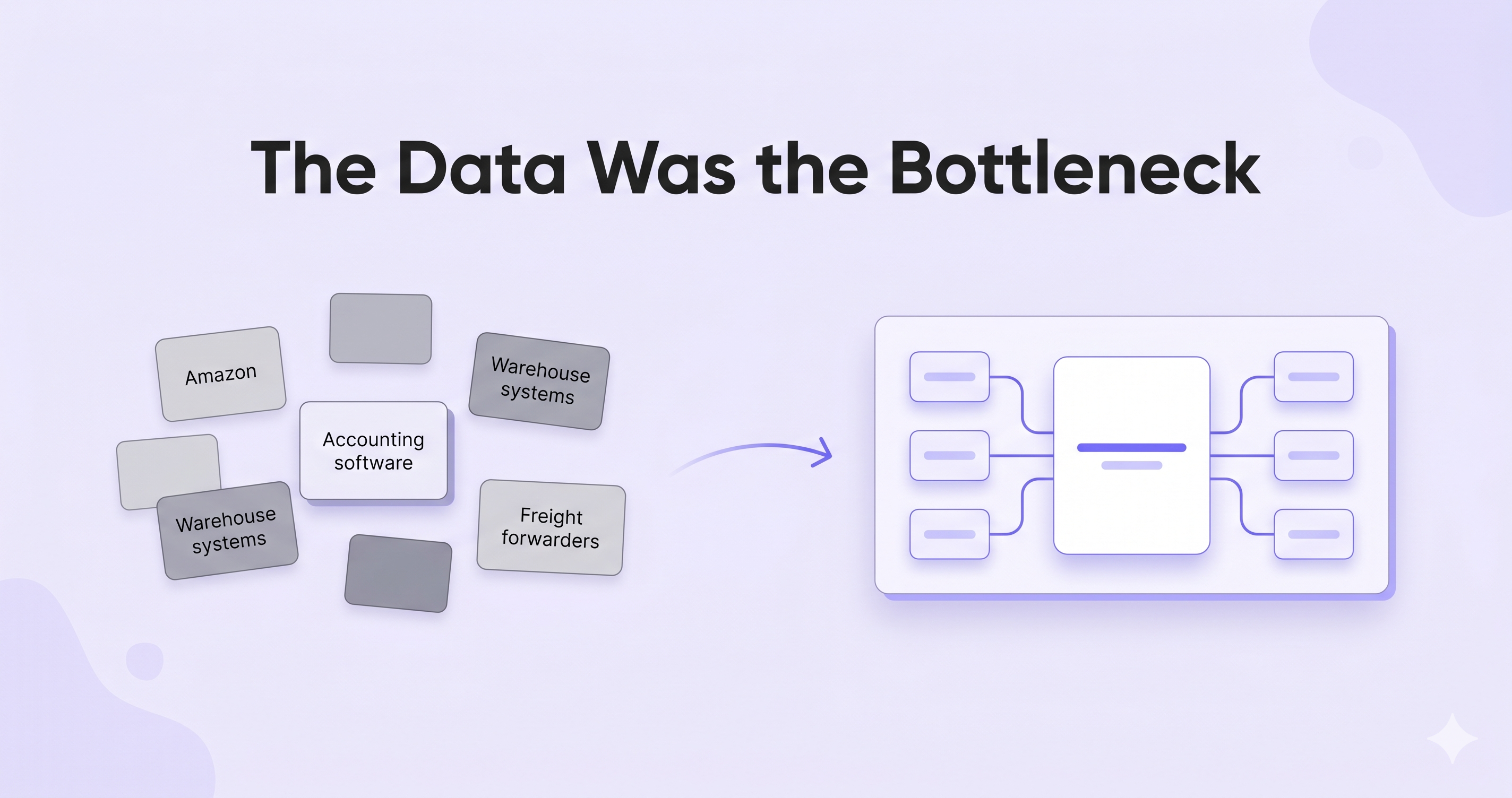
Amazon settlement data sits in Seller Central. Inventory counts are in your warehouse management system. Freight costs come from your forwarder's portal. Customs duties arrive in a customs broker's email. Accounting data lives in your ERP software. Sales and marketing metrics are scattered across Shopify, TikTok, and whatever other marketplaces you run.
Your teams are smart. Your tools are good. But they were never designed to talk to each other.
Most sellers live with this. Some spreadsheet their way through it. A few invest in connecting pieces—a Shopify sync here, an Amazon connector there—but even with those, the data layer remains fragmented. No single source of truth. No clean, unified picture of your business.
The Decision Velocity Problem
The real cost of fragmentation isn't spreadsheets. It's decision velocity.
Imagine your operations lead gets a straightforward question: "Should we replenish SKU X?"
What should be a five-minute decision turns into a two-hour reconciliation project. Pull current inventory from the warehouse system. Cross-check against Amazon's count. Account for in-transit stock. Verify the landed cost from the last purchase order. Look at lead times from your supplier. Confirm storage capacity. Check current demand velocity. Reconcile across systems because the numbers always seem slightly different.
Two hours later, you have an answer. Your ops team is exhausted. The decision is made, but slower than your market moves.
The same pattern repeats across your business. Your CFO needs profitability by SKU. Your founder wants to know if you're on track for Q2 targets. A customer inquires about a specific shipment. Each request requires the same manual verification dance across disconnected systems.
Your ops team spends its days validating data instead of analyzing it. Information that should take minutes to produce takes days. Decisions that should take hours take days. And by the time you have the answer, the moment to act may have passed.
What Unified Data Actually Enables
Here's what changes when your data is unified at the source:
Fast retrieval. The same replenishment question is answered in 30 seconds. Not because someone is faster, but because the data is there—one source of truth instead of six systems that disagree.
Automated audits. Discrepancies surface before they become problems. When inventory counts don't match, the system flags it. When landed cost calculations look off, it's visible. Your data stays audit-ready by design, not by luck.
Real-time clarity. Your leadership doesn't have to wait days for profitability numbers. Your CFO doesn't have to commission a deep-dive analysis. The system tells you where you stand, now.
A platform like NeonPanel centralizes your inventory, landed costs, COGS, and financial data into one unified layer. It includes 100+ built-in reports so you can pull exactly what you need without building queries. The data is clean, timestamped, and reconciled across Amazon, Shopify, accounting software, and your warehouses.
But having unified data and knowing what to do with it are two different things.
Beyond Reports—Domain Experts on Clean Data
The real competitive advantage isn't the reports. It's what you do on top of them.
Imagine putting a domain expert on top of that unified data—someone who knows e-commerce operations inside and out, has access to your real numbers in real time, and can pull insights and recommendations without you having to ask. Not a dashboard. Not a tool. A specialist agent that actually does the work.
This is what domain expert agents enable. They analyze your unified data. They flag opportunities (this SKU is underselling, we should replenish early). They catch risks (margin on this category is compressing). They interpret your data in context and recommend action. They remember what they've seen before, so they can hand off work to you or to other agents, building institutional knowledge.
The data was the bottleneck. It isn't anymore. Now the question is: what will you do with velocity?
Assess your decision velocity.
How much time is your team losing to data reconciliation? Take our quick audit to find out.
Further reading: A Month-End Checklist for Amazon Sellers · AI in the Accounting Industry · Best Tools for Amazon Seller Analytics
FAQ
What does "fragmented data" actually mean for my business?
A: Fragmented data means your business information is scattered across multiple disconnected systems—Amazon Seller Central, warehouse software, accounting tools, freight portals, etc. Each system has its own version of the truth, and they rarely agree. This forces your team to manually reconcile data from multiple sources before they can answer even simple questions, slowing down decision-making.
How much time does data fragmentation actually cost?
A: For most e-commerce operations teams, fragmented data creates 20–40 hours of monthly reconciliation work. A question that should take 30 minutes takes 2 hours because data needs to be verified across systems. Multiplied across dozens of decisions per month, this can represent 15–25% of your ops team's capacity lost to validation instead of strategy.
What's the difference between unified data and just having better reporting?
A: Better reporting shows you data. Unified data is the data. Reporting tools organize information after the fact. Unified data means one source of truth from the start—no reconciliation needed, no conflicting numbers, no waiting for verification. It's the foundation that makes faster decisions possible.
How does unified data help with decision velocity?
A: When your data is unified at the source, decisions that normally take hours take minutes. A replenishment question is answered instantly. Your CFO gets profitability by SKU without commissioning a deep dive. Your team spends time on strategy, not on validating numbers from six different systems.
What are domain expert agents, and how do they relate to data?
A: Domain expert agents are AI-powered specialists that analyze your unified data and recommend action. They know e-commerce operations and have access to your real-time numbers. Instead of you pulling reports and trying to interpret them, the agent pulls insights, flags risks, and recommends decisions. They work because the underlying data is clean and trustworthy.