

In this article Understanding the basics of e-commerce product demand forecasting Top Demand...

Mastering e-commerce demand forecasting is crucial for balancing inventory costs and customer satisfaction. Accurate demand forecasting enables businesses to predict market shifts, avoid overstocking or stockouts, and allocate capital efficiently, ensuring smoother growth.
In this article
Compare proven demand forecasting techniques for ecommerce and the inventory forecasting tools that automate them. Strong ecommerce demand forecasting separates baseline velocity from promos, lead-time variance, and stockout risk on real SKU history.
What Is Demand Forecasting in E-commerce?
Demand forecasting is the process of predicting future customer demand using historical sales, seasonal trends, and market conditions. This method helps ensure the right products are available at the right time, optimizing inventory and improving supplier negotiations.
Without accurate forecasting, you risk either running out of stock during peak periods or overstocking, which ties up valuable capital. The goal is to maintain the perfect balance.
This approach ensures the right products are available at the right time, reducing lost sales opportunities and minimizing unnecessary storage costs. By aligning purchasing decisions with projected demand, businesses can optimize inventory turnover, improve cash flow, and strengthen supplier negotiations.
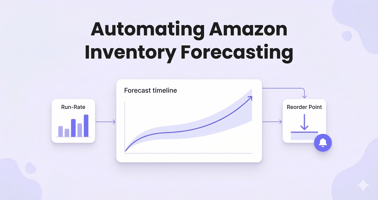
In today’s competitive digital environment, manual forecasting methods are often insufficient. That’s why many growing brands invest in demand forecasting automation for e-commerce. Automated systems use AI-driven analytics, machine learning algorithms, and integrated sales channels to continuously adjust forecasts based on live data. This significantly reduces human error and allows teams to react quickly to demand fluctuations.
Advanced demand forecasting e-commerce strategies also support:
- Multi-channel inventory planning
- Seasonal SKU performance analysis
- Promotional impact prediction
- Supply chain risk mitigation
Ultimately, businesses that implement scalable demand forecasting automation for e-commerce gain a measurable competitive advantage through data-driven inventory control and smarter growth planning.
Top Demand Forecasting Methods and Techniques
To forecast effectively, brands should use a blend of qualitative (expert insights) and quantitative (statistical models and historical data) methods. Key techniques include:
- Quantitative Methods: Using structured data to project future demand.
- Qualitative Methods: Applied when launching new products or entering markets without sufficient historical data.
- Macro- and Micro-Level Analysis: Considering both broad economic trends and internal variables like your specific marketing campaigns.
- Seasonal and Trend-Based Analysis: Distinguishing between temporary fads and reliable recurring peak seasons.
How to Optimize Your Planning Workflow
Optimizing your planning involves integrating advanced tools to ensure inventory aligns perfectly with market demand. Follow these key steps:
- Automate the Process: Manual analysis is time-consuming and prone to human error. Automation streamlines data collection, providing accurate, up-to-date forecasts without bottlenecks.
- Combine Quantitative and Qualitative Methods: Use your historical math models for established products, and supplement them with market research for new product launches.
- Leverage AI for Enhanced Forecasting: AI processes massive datasets to identify patterns—such as regional events or social media trends—that traditional methods may miss.
- Monitor and Adjust Regularly: Forecasting is not a one-time task. Review your projections based on new data to remain agile against market disruptions.
- Promote Cross-Department Collaboration: Marketing, operations, and finance teams must align on budgets, lead times, and promotional schedules to ensure forecasting accuracy.
The Role of Automation and AI
As operations scale, manual forecasting becomes impossible. Demand forecasting automation for e-commerce is necessary to manage thousands of SKUs across multiple platforms effectively. By providing real-time updates, these systems allow teams to move away from spreadsheet-heavy workflows and focus on strategic growth.
AI-powered tools take this further by factoring in external elements like weather or viral shifts, allowing for proactive rather than reactive inventory management.
AI vs Traditional Forecasting in E-commerce
| Aspect | Traditional Forecasting | AI Demand Forecasting (E-commerce) |
|---|---|---|
| Data processing | Manual or spreadsheet-based | Automated real-time processing |
| Accuracy | Limited by human analysis | Continuously improving with machine learning |
| Data sources | Historical sales only | Sales plus external factors (weather, trends, behavior) |
| Scalability | Difficult with large SKU catalogs | Easily scales across thousands of products |
| Reaction time | Reactive adjustments | Proactive forecasting and alerts |
| Optimization | Basic inventory planning | Advanced predictive inventory optimization |
The shift toward AI demand forecasting ecommerce solutions allows businesses to move beyond simple estimation models and adopt predictive intelligence that improves over time. This results in better stock availability, reduced holding costs, and more efficient supply chain operations.
Ultimately, combining automation with AI creates a forecasting system that not only predicts demand but also adapts to market changes in real time, giving e-commerce businesses a significant competitive advantage.
Conclusion
Successful demand forecasting requires clean data, cross-department alignment, and the right technology. By auditing your data collection and implementing automated, AI-driven systems, you can remove guesswork and make smarter decisions at scale. NeonPanel helps you stay lean, in stock, and profitable by unifying your planning across all channels.
Further reading: E-commerce Demand Forecasting · Cross-Channel Inventory Forecasting · Stockout Prediction & Automated Replenishment
FAQ
What are the most effective demand forecasting methods for startups?
A: Startups should combine qualitative methods like market research with simple forecasting techniques based on recent sales data. As the business grows, more complex models can be phased in.
How does AI-enhanced demand forecasting software improve accuracy?
A: AI improves accuracy by analyzing complex, non-linear patterns and incorporating external variables like weather, regional events, or social media trends that traditional models often omit.
What is the difference between demand forecasting and sales planning?
A: Demand forecasting predicts future customer behavior based on market data, while sales planning sets specific business targets and goals meant to be achieved against those forecasts.
How to choose the right e-commerce demand forecasting software?
A: Look for software that integrates deeply with your current sales channels, provides SKU-level granularity, supports automated replenishment alerts, and offers clear scalability for your future growth.
Why is automating demand forecasting important for scaling in e-commerce?
A: Automation eliminates manual data entry, reducing human error while enabling the management of large, multi-channel product catalogs that are impossible to track manually.