

What is Landed Cost and Why It Matters in Business In this article What Is Landed Cost? How to...
In this article
- What Is COGS?
- What Are Operating Expenses?
- COGS vs Operating Expenses: Key Differences
- Real-World Example: COGS vs Operating Expenses
- How CapEx Differs From COGS and OpEx
- Where Common E-commerce Costs Belong
- What Is Included in COGS but Not Operating Expenses
- Common Operating Expenses Every Business Should Track
- How COGS and Operating Expenses Affect Profitability
- Common Mistakes When Classifying Business Expenses
- How to Reduce COGS and Operating Expenses Without Hurting Growth
- COGS vs Operating Expenses: Which Metric Matters More?
- Why Understanding the Difference Matters for Your Business
- Conclusion
- FAQ
COGS (Cost of Goods Sold) and operating expenses both reduce profit, but they answer different questions. COGS measures the direct cost of the products you sell. Operating expenses measure the ongoing cost of running the business. Mixing them up distorts gross margin, pricing, and how you read the P&L.
This article explains what belongs in each category, shows a practical example, walks through how both affect profitability, and covers common classification mistakes — so finance and ops can make decisions from the same numbers.
What Is COGS?
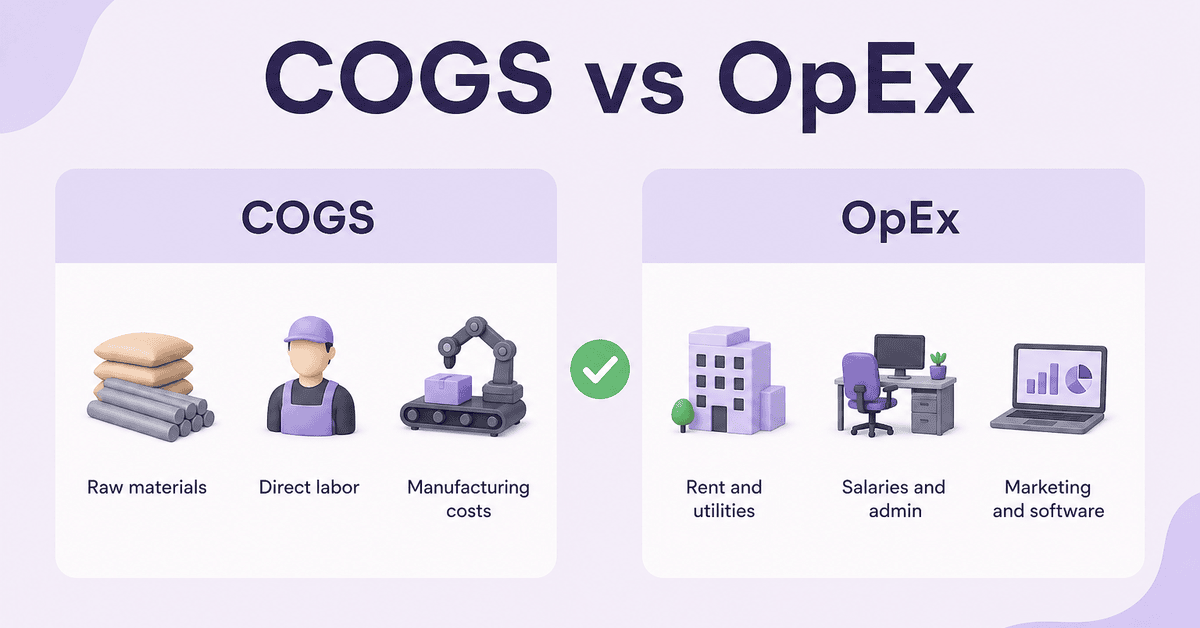
Cost of Goods Sold (COGS) represents the direct costs a business incurs to produce or purchase the products it sells during a specific accounting period. It includes expenses that are directly tied to creating or acquiring inventory, making it one of the most important figures on an income statement.
A simple COGS vs operating expenses definition starts with understanding that COGS covers only costs directly related to delivering a product or service. Typical examples include raw materials, manufacturing labor, production supplies, and certain factory overhead costs. For retailers, COGS generally refers to the purchase cost of inventory that has been sold.
Because COGS is deducted from revenue to calculate gross profit, it plays a critical role in measuring how efficiently a company produces and sells its products. Lower production costs or better inventory management can improve gross margins without necessarily increasing sales.
Although the exact components of COGS vary by industry, the underlying principle remains the same: if a cost is directly required to produce or acquire what a customer buys, it is generally considered part of Cost of Goods Sold rather than a general business expense.
For a set period, COGS is usually calculated as beginning inventory plus purchases minus ending inventory. For an e-commerce seller, the cost of each unit is its landed cost: the supplier price plus inbound freight, customs duties, and prep. The inventory method then decides which unit costs reach the income statement first. Under FIFO, the oldest batch sells first, so COGS reflects what you paid for the units that actually left, while the average cost method blends older and newer batches into one figure. NeonPanel's landed cost management assigns landed cost to each receipt batch and consumes batches in FIFO order, so gross margin per SKU matches the real cost of the units sold.
What Are Operating Expenses?
Operating expenses are the ongoing costs required to run a business that are not directly tied to producing goods or delivering inventory. These expenses support daily operations, sales, administration, and business growth, regardless of how many products are sold.
When comparing operating expenses vs COGS, the key distinction is that operating expenses keep the business functioning, while COGS is directly associated with the products or services sold. Common operating expenses include office rent, employee salaries for administrative staff, marketing campaigns, software subscriptions, insurance, utilities, legal and accounting services, and other overhead costs.
Unlike COGS, operating expenses are deducted after gross profit is calculated. As a result, they have a direct impact on operating income and overall profitability rather than on gross margin.
Every business has operating expenses, whether it manufactures products, sells goods online, or provides professional services. Tracking these costs accurately helps companies control spending, prepare reliable budgets, and identify opportunities to improve efficiency without affecting product quality or customer experience.
COGS vs Operating Expenses: Key Differences
Understanding the COGS vs operating expenses relationship is essential for accurate financial reporting and better business decision-making. While both are necessary costs of running a business, they affect financial statements in different ways and measure different aspects of performance.
The main COGS vs operating expenses difference is that COGS includes only the direct costs of producing or acquiring products that have been sold, whereas operating expenses cover the indirect costs of running the business. This distinction influences gross profit, operating income, pricing strategies, and overall financial analysis.
| Category | COGS | Operating Expenses |
|---|---|---|
| Purpose | Direct costs of producing or purchasing goods sold | Costs of running the business |
| Examples | Raw materials, production labor, inventory costs | Rent, marketing, office salaries, software, insurance |
| Reported in Income Statement | Before gross profit | After gross profit |
| Changes With Sales Volume | Usually variable | Can be fixed, variable, or mixed |
| Primary Financial Impact | Gross profit | Operating income |
Although both categories reduce a company's profit, they answer different business questions. COGS helps measure how efficiently products are produced or sourced, while operating expenses show how efficiently the business is managed outside of production. Correctly separating these costs provides a clearer picture of financial performance and supports more informed budgeting and pricing decisions.
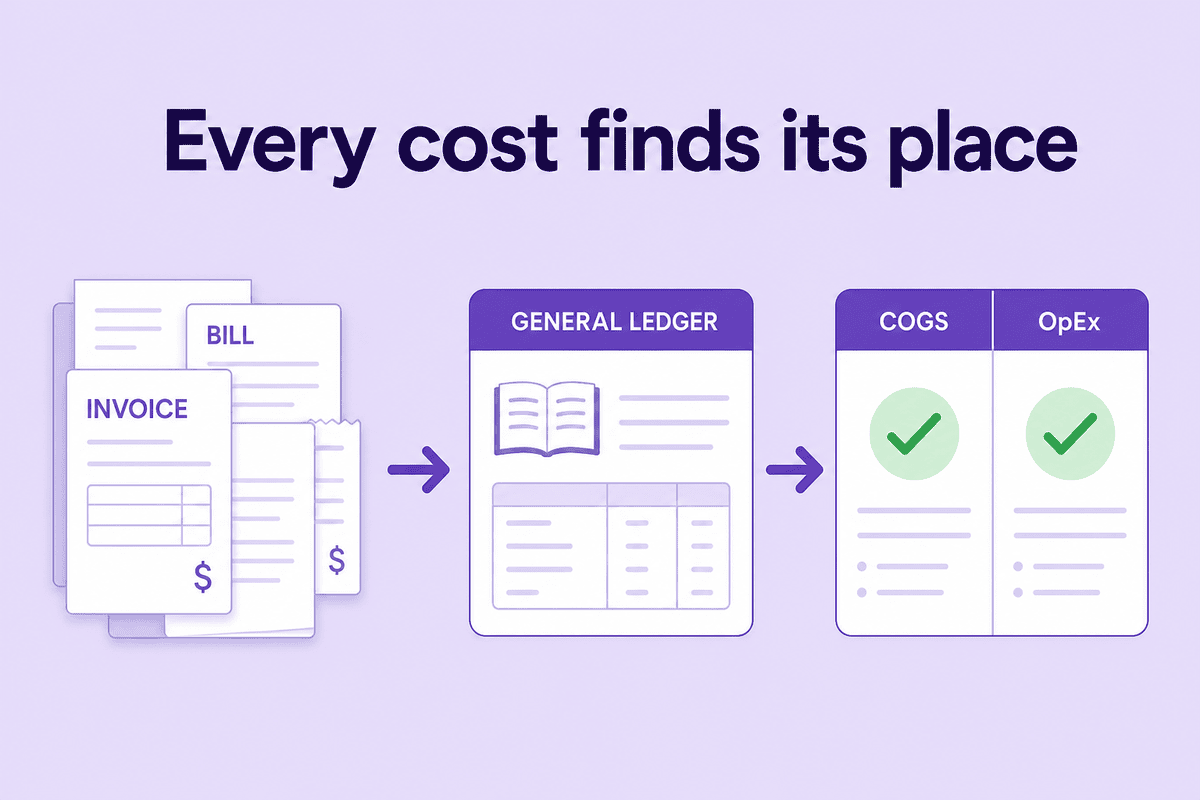
Every cost finds its place — direct product costs in COGS, overhead in operating expenses.
Real-World Example: COGS vs Operating Expenses
Take a private-label seller on Amazon. For this seller, the COGS vs operating expenses split starts with landed cost: the supplier invoice for the units, freight from the factory to the warehouse, customs duties, and prep and labeling before the stock ships to FBA. These costs go on the balance sheet as inventory first and become COGS when the units sell. Stock still sitting in FBA at the end of the month stays in inventory.
Everything else the seller spends to run the business is an operating expense: PPC campaigns, salaries, the Professional selling plan, accounting and analytics software, and FBA storage fees. None of these costs attach to a particular unit, and most of them keep running in a slow month.
Amazon referral and FBA fulfillment fees are the harder call. They grow with every order, yet Amazon charges them for access to its channel and fulfillment network. The section on e-commerce costs below covers how sellers treat them.
How CapEx Differs From COGS and OpEx
Capital expenditures (CapEx) sit outside the cost of goods sold vs operating expenses split. They cover assets your business will use for more than a year, such as warehouse racking, packing equipment, or custom inventory software. These purchases go on the balance sheet as assets instead of hitting the income statement in the month you pay.
The cost reaches the P&L later through depreciation or amortization, spread over the asset's useful life. If you manufacture, depreciation on production equipment goes into COGS. For a reseller, depreciation on racking, packing stations, and software usually falls under operating expenses.
Where Common E-commerce Costs Belong
The general rule settles most costs. For a handful of e-commerce costs, the operating expense or COGS decision depends on accounting policy, and sellers classify them differently.
| Cost | Usual treatment | Why |
|---|---|---|
| Inbound freight and customs duties | COGS | Part of landed cost: you pay them to get inventory to the warehouse |
| Prep, labeling, and product packaging | COGS | Needed to make the unit sellable |
| Shipping to the customer | Either | Some sellers count it as a cost of delivering the product, others as a fulfillment expense |
| FBA fulfillment fees | Either | Charged per unit sold, but paid to a sales channel for its service |
| Marketplace referral fees | Operating expense | A cost of selling through the channel |
| Payment processing fees | Operating expense | A cost of collecting money |
| Storage fees | Operating expense | Build up with time in the warehouse, not with units sold |
| Customer refunds | Reduce revenue | Money returned to the buyer |
For the costs marked "Either," consistency matters more than the choice itself. Pick one treatment, write it into your chart of accounts, and keep it for the whole fiscal year, or your gross margin trend will jump for reasons that have nothing to do with the business.
NeonPanel's automated data entry maps Amazon settlement fees and refunds to your chart of accounts in QuickBooks or Xero, so each fee type posts to the same category every month.
What Is Included in COGS but Not Operating Expenses
One of the easiest ways to distinguish operating costs vs COGS is to identify whether an expense is directly required to produce or acquire the product being sold. If the cost would not exist without the product itself, it generally belongs in COGS rather than operating expenses.
Costs commonly included in COGS include:
- Direct materials used to manufacture or assemble a product.
- Direct labor for employees whose work is directly involved in production.
- Manufacturing overhead that supports the production process, such as factory equipment depreciation or production utilities.
- Inventory acquisition costs, including the purchase price of goods intended for resale.
- Production packaging that is necessary to prepare products for sale.
These costs are closely tied to sales activity and typically increase or decrease as production volume changes. In contrast, expenses such as office rent, advertising, administrative salaries, or accounting services support the business overall rather than the production of individual products.
Correctly identifying which expenses belong in COGS ensures more accurate gross profit calculations and provides a clearer understanding of production efficiency.
Common Operating Expenses Every Business Should Track
When comparing operating expenses vs COGS, it's helpful to focus on the costs that keep a business running regardless of how many products it sells. These expenses support administration, sales, customer service, and overall operations rather than the production process.
Common operating expenses include:
- Office and retail rent
- Utilities, internet, and phone services
- Salaries for administrative and management staff
- Marketing and advertising campaigns
- Accounting, legal, and consulting services
- Software subscriptions and cloud-based tools
- Insurance premiums
- Office supplies and equipment maintenance
Although some operating expenses may fluctuate over time, many are fixed or semi-fixed costs that businesses must pay even during slower sales periods. Monitoring these expenses helps business owners identify unnecessary spending, improve budgeting, and maintain healthy operating margins.
Accurate expense classification also makes financial reports easier to interpret, allowing managers and investors to evaluate operating efficiency separately from production costs.
How COGS and Operating Expenses Affect Profitability
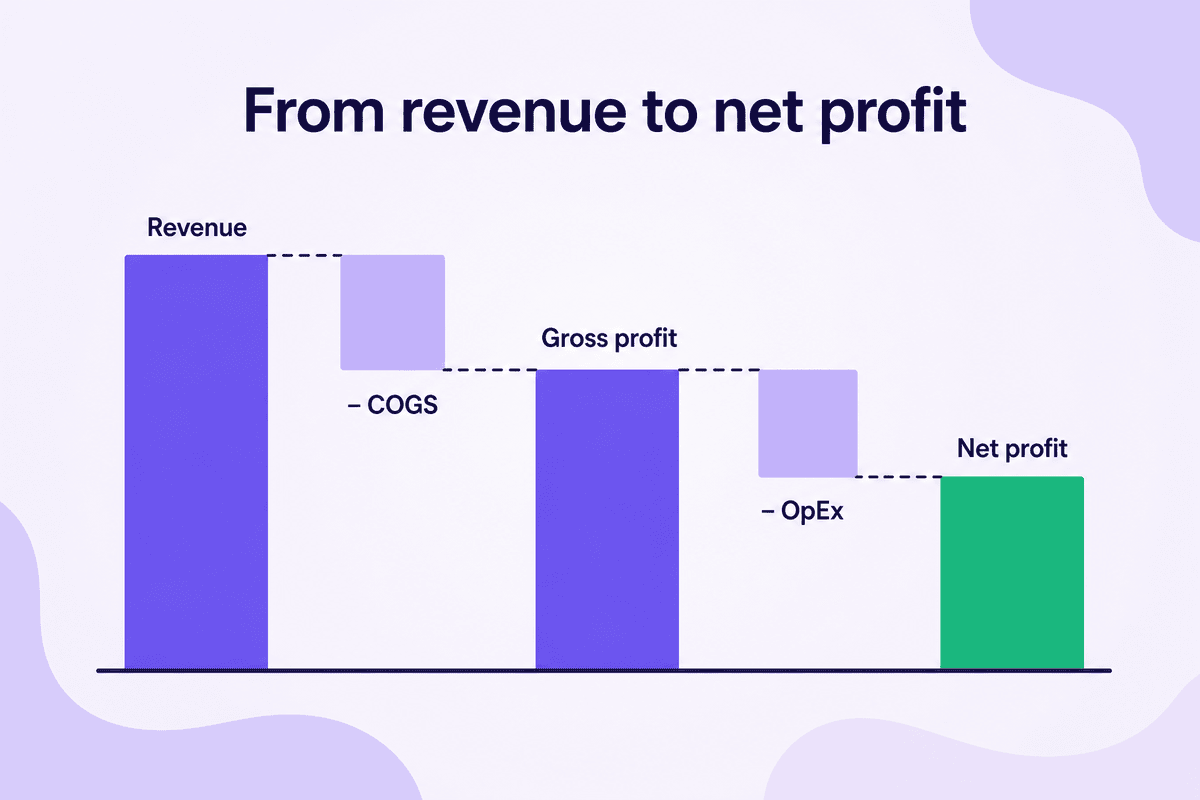
Revenue minus COGS is gross profit; subtract operating expenses to reach net profit.
COGS and operating expenses influence different stages of a company's income statement, which is why tracking both categories is essential for evaluating financial performance. While they both reduce profit, they measure different aspects of business efficiency.
COGS is deducted from revenue first to calculate gross profit. This metric shows how efficiently a business produces or purchases the products it sells. Lower production or inventory costs typically lead to higher gross margins.
Operating expenses are deducted after gross profit to determine operating income. These costs reflect how efficiently the business is managed, including administration, marketing, and other day-to-day functions. Together, COGS and operating expenses ultimately determine net profit, making accurate classification essential for reliable financial reporting.
| Financial Metric | Includes COGS | Includes Operating Expenses | What It Measures |
|---|---|---|---|
| Gross Profit | ✓ | – | Profit after direct production or inventory costs |
| Operating Income | ✓ | ✓ | Profit from core business operations |
| Net Profit | ✓ | ✓ | Final profit after all business expenses |
Reviewing these metrics together helps business owners understand whether profitability is being affected by production costs, operating overhead, or a combination of both. This insight supports better pricing decisions, cost management, and long-term financial planning.
In formula form:
Revenue − COGS = Gross profit
Gross profit − Operating expenses = Operating income
Dividing each result by revenue gives gross margin and operating margin, the two percentages most sellers track month to month.
Businesses that sell across multiple channels often struggle to keep financial and operational data aligned. Using a centralized platform such as NeonPanel helps finance and operations teams work from the same live data, reducing manual reconciliation and providing more accurate insights into both direct production costs and operating expenses.
Common Mistakes When Classifying Business Expenses
Accurately classifying business expenses is essential for reliable financial reporting. Even small mistakes can distort gross profit, operating income, and other key performance metrics, making it harder to evaluate the true health of a business.
Some of the most common classification errors include:
- Recording administrative or office salaries as production costs.
- Including advertising and marketing expenses in COGS.
- Treating office supplies or software subscriptions as inventory costs.
- Misclassifying shipping expenses without considering whether they relate to acquiring inventory or delivering products to customers.
- Failing to separate production-related costs from general business overhead.
These errors often occur because certain expenses support multiple business functions. For example, employee wages may be classified differently depending on whether the employee works in manufacturing, sales, or administration. Likewise, shipping costs may be treated differently based on accounting policies and the stage of the sales process.
Reviewing expense classifications regularly and following consistent accounting practices helps businesses produce more accurate financial statements, improve budgeting, and make better-informed decisions based on reliable financial data.
How to Reduce COGS and Operating Expenses Without Hurting Growth
Reducing business costs should focus on improving efficiency rather than simply cutting spending. A balanced approach allows companies to protect product quality, maintain customer satisfaction, and support long-term growth while improving profitability.
Practical ways to lower costs include:
- Negotiate better pricing with suppliers and review vendor contracts regularly.
- Improve inventory management to reduce waste, excess stock, and storage costs.
- Streamline production processes to minimize material loss and labor inefficiencies.
- Automate repetitive administrative tasks using accounting and workflow software.
- Review recurring subscriptions and eliminate tools that are no longer essential.
- Monitor marketing performance and invest in channels that deliver measurable returns.
- Analyze utility, facility, and operating costs to identify opportunities for savings.
Not every expense should be reduced. Investments in product quality, employee development, customer service, and technology often contribute to sustainable business growth, even if they increase short-term costs.
The goal is to distinguish between expenses that create long-term value and those that add unnecessary overhead. Regular financial reviews and performance analysis help businesses identify cost-saving opportunities without compromising their ability to compete or serve customers effectively.
NeonPanel's automatic COGS posts the cost of goods sold to QuickBooks or Xero as units sell, so purchases stay in inventory until then.
COGS vs Operating Expenses: Which Metric Matters More?
Neither metric is more important than the other because each answers a different financial question. COGS measures the direct cost of producing or acquiring the goods or services a business sells, while operating expenses reflect the cost of running the business beyond production.
For example, a company may have an excellent gross profit because it keeps production costs low, but still struggle with profitability due to high marketing, administrative, or facility expenses. On the other hand, a business with well-controlled operating expenses may see weak financial results if its production costs continue to rise.
Rather than focusing on a single metric, businesses should evaluate both together. Comparing trends over time helps identify whether changes in profitability are driven by production efficiency or by day-to-day operating costs. This broader perspective supports more informed decisions about pricing, budgeting, hiring, and investment.
The most successful companies monitor both categories consistently, using them as complementary indicators to improve financial performance and support sustainable growth.
Why Understanding the Difference Matters for Your Business
Knowing how to distinguish between COGS and operating expenses is more than an accounting exercise – it directly influences how a business plans, grows, and measures success. Accurate expense classification provides a clearer view of financial performance and supports better decision-making at every stage.
When costs are recorded correctly, businesses can:
- Set prices that protect healthy profit margins.
- Build more accurate budgets and financial forecasts.
- Evaluate product profitability with greater confidence.
- Identify opportunities to improve operational efficiency.
- Produce reliable financial reports for investors, lenders, or stakeholders.
Understanding the difference also helps managers recognize where costs are increasing. If gross profit declines, the issue may lie in production or inventory costs. If operating income falls while gross margins remain stable, overhead expenses may require closer attention.
Over time, consistently tracking both categories enables businesses to make informed strategic decisions, allocate resources more effectively, and respond more quickly to changes in market conditions. Rather than relying on assumptions, companies can use financial data to guide sustainable growth and improve overall business performance.
Conclusion
Although both COGS and operating expenses reduce a company's profit, they serve different purposes in financial reporting. COGS measures the direct costs of producing or acquiring the goods and services a business sells, while operating expenses reflect the ongoing costs of running the business.
Understanding this distinction helps businesses calculate key financial metrics correctly, evaluate profitability, and make more informed decisions about pricing, budgeting, and cost management. Accurate expense classification also improves the quality of financial reporting, making it easier to identify opportunities for greater efficiency and long-term growth.
Whether you're managing a small business or a growing enterprise, regularly reviewing both categories provides a more complete picture of financial performance and supports better strategic planning. Consistent tracking and analysis can help businesses strengthen profitability while maintaining sustainable operations.
Need true SKU-level COGS and a finance-ready P&L across marketplaces? Explore NeonPanel Accounting or start free.
Further reading: What Is COGS and How to Calculate It · COGS vs Landed Cost · Amazon Seller Bookkeeping Guide
FAQ
⌃What happens if COGS is recorded as an operating expense?
Gross profit and gross margin come out higher than they really are, while operating expenses look inflated. Operating income and net profit stay the same, because both categories are subtracted before them.
⌃Is COGS an operating expense?
No. Both are operating costs, but COGS sits on its own line above gross profit, and operating expenses are subtracted after it.
⌃Is inventory COGS or an operating expense?
Neither when you buy it. Inventory is an asset on the balance sheet, and its cost moves to COGS only when the units sell. Unsold stock never becomes an operating expense.
⌃Is shipping COGS or an operating expense?
Freight to bring inventory to your warehouse is COGS, as part of landed cost. Shipping orders to customers can go either way, so pick one treatment and apply it every month.
⌃Are Amazon fees COGS or operating expenses?
Referral fees are an operating expense, a cost of selling through Amazon. FBA fulfillment fees are not part of inventory cost either, so they stay out of COGS in accounting terms, though some sellers show them on a separate cost-of-sales line for margin analysis.
⌃Are salaries COGS or operating expenses?
It depends on the role. Wages for people who produce the goods go into COGS, while admin, sales, marketing, and management salaries are operating expenses. For a reseller, most salaries are operating expenses.