
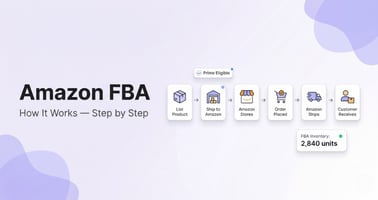
Fulfillment by Amazon (FBA) is the logistics model that lets sellers store inventory inside...

In this article
- What Determines Amazon FBA Profitability?
- Understanding Amazon FBA Profit Margins
- What Does It Cost to Sell on Amazon FBA?
- How to Calculate Amazon FBA Profit
- Amazon FBA Profit Example
- How Much Do Amazon FBA Sellers Actually Make?
- What Can Reduce Your Amazon FBA Profit?
- How to Improve Amazon FBA Profitability
- How to Check If an Amazon FBA Product Is Profitable Before Launch
- What Is a Good Amazon FBA Profit Margin for Your Product?
- FAQ
How to Calculate True Profit on Amazon FBA: A Complete Guide
Amazon FBA can be profitable, but sales revenue alone does not tell you whether a product is actually making money. Amazon fees, product costs, fulfillment, advertising, storage, returns, and other operating expenses can significantly reduce the amount left from each sale.
The right way to evaluate an FBA business is to calculate true net profit at the product and business level. This means accounting for all relevant costs rather than subtracting only the product cost and Amazon's basic fees.
In this guide, we'll look at what determines Amazon FBA profit, how to calculate profit margin, which costs matter most, how much sellers can potentially earn, and how to evaluate a product before investing in inventory.
What Determines Amazon FBA Profitability?
The basic economics of an FBA product are straightforward: you sell a product for a certain price and keep what remains after all associated costs have been paid. However, the number that appears in Seller Central as sales revenue is only the starting point. Amazon FBA profitability depends on how efficiently a product converts revenue into net profit.
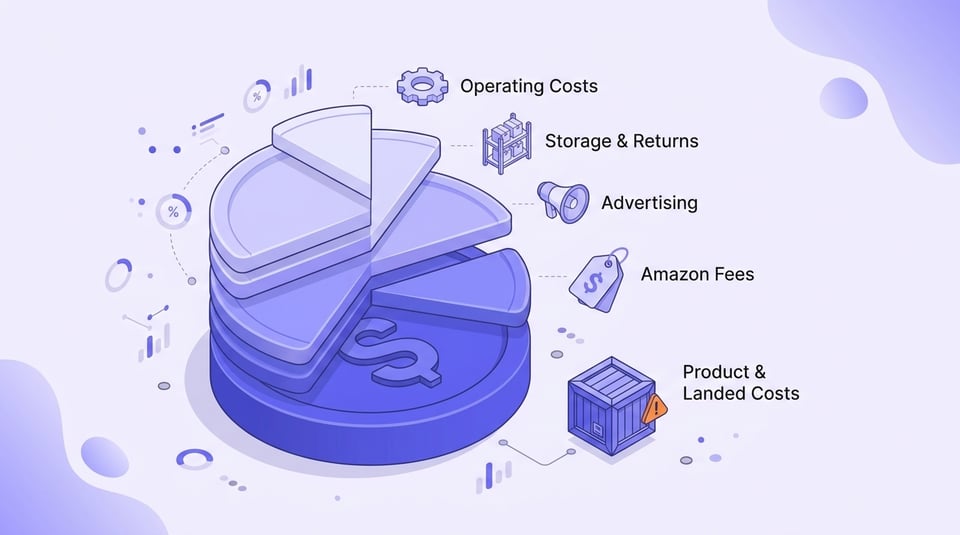
The main variables are:
- Selling price and sales volume
- Product and landed costs
- Amazon selling and fulfillment fees
- Advertising expenditure
- Storage and inventory costs
- Returns and refunds
- Freight, preparation, and other logistics expenses
- Software, labor, and other operating expenses
For example, a product selling for $40 may initially appear attractive if it costs $10 to manufacture. But after referral fees, fulfillment, PPC advertising, freight, storage, returns, and other expenses, the actual profit may be considerably lower.
This is why a product with high revenue is not automatically a profitable product. Amazon FBA can still be a viable business model when the underlying unit economics are strong. The important question is not simply how much a product sells for, but how much money remains after the complete cost of generating and fulfilling that sale.
For businesses managing several products, Amazon seller analytics can also help compare sales and performance across SKUs instead of relying on overall revenue figures.
Understanding Amazon FBA Profit Margins
Profit margin shows how much of your revenue remains as profit after the relevant costs have been deducted.
Three numbers are particularly important:
| Metric | Calculation | What it tells you |
|---|---|---|
| Revenue | Selling price × units sold | Total sales generated |
| Net profit | Revenue − total costs | Money remaining after expenses |
| Profit margin | Net profit ÷ revenue × 100 | Profit as a percentage of sales |
It is important to distinguish gross profit from net profit. Gross profit generally focuses on revenue after direct product costs, while net profit accounts for the broader set of expenses required to operate the business.
What Is a Good Profit Margin for Amazon FBA?
There is no universal profit margin that makes an Amazon product successful. A margin that works for one business may be too low for another because sellers have different advertising costs, operating expenses, inventory requirements, and growth strategies.
A useful benchmark should therefore be treated as a reference point rather than a guarantee.
A product with a 30% net margin may have plenty of room to absorb unexpected expenses and reinvest in growth. A product with a 10% margin may still work if sales volume and inventory turnover are strong, but it has less room for mistakes.
The most useful approach is to evaluate margin alongside:
- sales velocity;
- inventory turnover;
- advertising efficiency;
- return rates;
- cash tied up in inventory;
- total investment required.
A high margin with very low demand is not necessarily better than a moderate margin with consistent sales.
What Does It Cost to Sell on Amazon FBA?
Understanding Amazon FBA costs is essential because expenses occur at several different stages of the product lifecycle.
Product and Landed Costs
The first group of costs exists before the product reaches the customer.
This can include:
- manufacturing or wholesale cost;
- international freight;
- customs and duties;
- inspection;
- packaging;
- product preparation;
- shipping inventory to Amazon.
Together, these expenses form the product's landed cost. Using an accurate landed cost is important because comparing the selling price only with the supplier's unit price can make a product appear more profitable than it really is.
If inventory is purchased for $8 per unit but freight, duties, packaging, and preparation add another $2, the relevant product cost for profitability calculations is $10, not $8.
Amazon Selling and FBA Fees
Amazon charges several types of fees depending on the product, category, size, weight, and fulfillment method.
Common Amazon FBA fees can include:
- referral fees;
- FBA fulfillment fees;
- storage fees;
- returns-related costs;
- removal or disposal fees;
- other applicable selling or fulfillment charges.
The exact fee structure can change, so sellers should use current Amazon fee information and appropriate calculation tools when estimating profitability.
Advertising and Operating Costs
Advertising is another major factor. A product can have attractive economics before advertising but become much less profitable once PPC expenditure is included.
Other operating costs can include software subscriptions, employees or contractors, professional services, photography, design, customer service, and other business expenses.
These costs should be considered when calculating true business-level profit rather than treating Amazon fees as the only expense beyond COGS.
For a broader view of financial management, Amazon seller accounting can help connect sales, costs, and financial reporting.
How to Calculate Amazon FBA Profit
The most reliable method is to calculate profit from the bottom up.
Start with the actual selling price and then subtract every significant cost associated with generating that sale.
Amazon FBA Profit Formula
Net Profit = Revenue − Product Costs − Amazon Fees − Advertising − Other Operating Costs
For a single unit, the calculation can be simplified to:
Profit Per Unit = Selling Price − Total Cost Per Unit
Total cost per unit should include the costs that can reasonably be attributed to that product and sale.
A practical calculation process is:
- Determine the realistic selling price.
- Calculate the product's landed cost.
- Estimate Amazon selling and FBA fees.
- Estimate advertising expenditure per sale.
- Include storage, returns, and other applicable costs.
- Subtract the total costs from revenue.
- Compare the result with the original investment.
This calculation should be performed using realistic assumptions rather than an ideal selling price or minimum possible advertising cost.
Amazon FBA Profit Margin Formula
Once net profit has been calculated, the margin is straightforward:
Profit Margin = Net Profit ÷ Revenue × 100
For example, suppose a product sells for $30 and the total cost associated with that sale is $21.
$30 − $21 = $9 profit
Then:
$9 ÷ $30 × 100 = 30% profit margin
That 30% figure is much more useful than looking at the $30 sale itself because it shows how much of the revenue the business actually retains.
Amazon FBA Profit Example
Consider a hypothetical product with the following unit economics:
| Per-unit economics | Amount |
|---|---|
| Selling price | $30.00 |
| Product + landed cost | $8.00 |
| Amazon fees | $7.00 |
| Advertising | $3.00 |
| Storage, returns & other costs | $2.00 |
| Net profit | $10.00 |
| Profit margin | 33.3% |
The calculation is:
$30 − $8 − $7 − $3 − $2 = $10 net profit
The resulting margin is:
$10 ÷ $30 × 100 = 33.3%
If the seller moves 1,000 units under the same assumptions, the simplified product-level profit would be:
1,000 × $10 = $10,000
This is an illustrative example, not a prediction of typical FBA earnings. Actual results can change significantly when selling prices, advertising costs, returns, fees, or inventory costs change.
For example, if advertising increases from $3 to $5 per order, profit falls from $10 to $8 per unit. At 1,000 units, that difference represents $2,000 less profit.
That is why profitability should be monitored continuously rather than calculated only when a product is launched.
How Much Do Amazon FBA Sellers Actually Make?
There is no single income figure that represents the typical Amazon FBA seller.
Seller income depends on:
- number of products;
- units sold;
- average selling price;
- profit per unit;
- advertising costs;
- inventory investment;
- operating expenses;
- business maturity.
Two sellers can generate the same revenue and have very different profits.
For example, Seller A might generate $100,000 in monthly revenue with a 10% net margin, producing $10,000 in profit. Seller B might generate $60,000 with a 25% margin, producing $15,000 in profit.
This illustrates why revenue rankings alone can be misleading. The objective is not necessarily to maximize sales at any cost. It is to build a business where sales generate sufficient profit relative to the capital and operational effort required.
Seller-level benchmarks can be useful for context, but they should not replace product-level calculations. Your own unit economics provide a much more reliable estimate of what a particular product can contribute.
What Can Reduce Your Amazon FBA Profit?
Even a product that looks profitable in an initial spreadsheet can underperform once it is operating at scale.
Some of the most common problems are:
- High advertising costs: Increased PPC spend can quickly reduce contribution margin.
- Price competition: Lowering the selling price reduces the amount available to cover fixed and variable costs.
- Slow inventory turnover: Stock that sits in fulfillment centers ties up capital and can increase storage costs.
- High return rates: Refunds and associated costs reduce realized revenue.
- Unexpected logistics costs: Freight and preparation expenses can increase the true landed cost.
- Fee changes: Amazon fees can change over time and affect previously calculated margins.
- Excess inventory: Purchasing too much stock can create additional carrying costs and cash-flow pressure.
- Low conversion rates: More advertising may be required to generate each sale.
Inventory is particularly important because profitability is not only about what happens when an order is placed. Capital remains tied up while products are being manufactured, shipped, stored, and sold.
Using Amazon inventory management can help sellers monitor stock levels and make purchasing decisions with inventory economics in mind.
How to Improve Amazon FBA Profitability
Improving profitability does not necessarily mean simply increasing the selling price. The strongest improvements usually come from managing several parts of the unit economics at the same time.
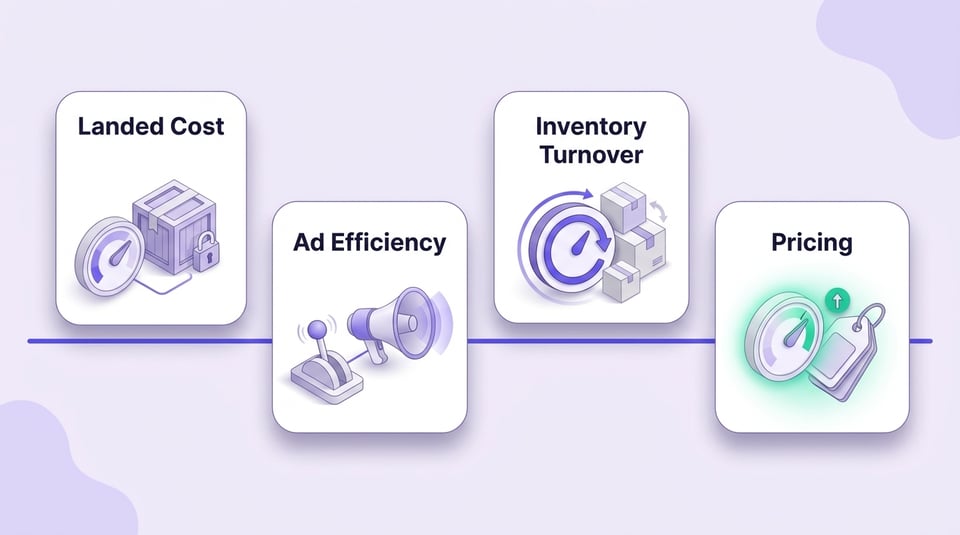
- Reduce Landed Product Costs — Negotiate supplier pricing, review packaging requirements, compare shipping options, and identify unnecessary preparation expenses. Even a small reduction in landed cost can have a significant effect when multiplied across thousands of units.
- Improve Advertising Efficiency — PPC should be evaluated in relation to the profit generated by each order. Increasing sales is useful only when the additional revenue produces enough contribution to justify the advertising expense.
- Improve Inventory Turnover — Avoiding excess inventory can reduce storage costs and release cash for more productive uses. Demand planning and inventory forecasting can help align purchases with expected sales.
- Monitor Profit by SKU — An overall business margin can hide products that are losing money and products that are carrying the business. Reviewing profitability at SKU level makes it easier to identify which products deserve more inventory, advertising, or pricing attention.
- Review Pricing Regularly — Pricing should reflect changes in competition, demand, Amazon fees, product costs, and advertising efficiency. A product that was profitable at launch may require a different price later.
Track Amazon FBA Profitability with NeonPanel
Calculating Amazon FBA profit gets harder as you add more products, fees, advertising costs, and inventory. NeonPanel brings your Amazon financial and operational data together, so you can look beyond sales revenue and see what each product is actually contributing to the business.
With Amazon Profit Analytics, you can analyze profitability at the SKU level, review margins and advertising costs, and see how individual products perform over time. NeonPanel also uses batch-level FIFO costing and landed costs to give you a more accurate view of COGS and product profitability.
How to Check If an Amazon FBA Product Is Profitable Before Launch
The best time to discover that a product has weak economics is before purchasing inventory.
A pre-launch profitability check should follow a consistent process:
- Estimate a realistic selling price based on the market.
- Calculate the complete landed product cost.
- Estimate applicable Amazon fees.
- Estimate FBA fulfillment and storage costs.
- Include a realistic advertising assumption.
- Account for returns and other relevant expenses.
- Calculate expected net profit per unit.
- Calculate profit margin and ROI.
- Test the model under less favorable assumptions.
For example, run the calculation again with a lower selling price, higher advertising costs, or higher product costs. If the product becomes unprofitable after a relatively small change in assumptions, the business may have limited room for error.
An Amazon FBA calculator can be useful for estimating Amazon-related costs and comparing fulfillment economics. However, a calculator should be treated as one part of the analysis. It does not automatically account for every business expense, so the final profitability model should include costs outside Amazon as well.
What Is a Good Amazon FBA Profit Margin for Your Product?
A good margin is one that provides enough room to cover operating risks while generating an acceptable return on the capital invested in inventory.
Consider these scenarios:
| Scenario | What it can mean |
|---|---|
| High margin, low sales | Attractive economics but limited demand |
| Low margin, high sales | Strong volume but greater sensitivity to costs |
| High margin, strong demand | Potentially strong product economics |
| Falling margin | Pricing or cost structure may need attention |
The most useful measurement is therefore not a standalone margin percentage. Look at profit per unit, sales velocity, inventory turnover, advertising efficiency, and return on invested capital together.
A product with a slightly lower margin may be more attractive if it sells consistently and requires less capital to maintain. Conversely, a high-margin product can become problematic if inventory sits for months without sufficient demand.
FAQ
⌃ How much profit can you make with Amazon FBA?
There is no fixed amount. Profit depends on selling price, sales volume, product costs, Amazon fees, advertising, inventory costs, and operating expenses. The most reliable estimate comes from calculating net profit per unit and multiplying it by realistic sales volume.
⌃ Is Amazon FBA still profitable?
Yes, Amazon FBA can still be profitable when a product has strong unit economics and sufficient demand. However, profitability depends on the complete cost structure rather than revenue alone. Product costs, FBA fees, advertising, inventory, and competition can significantly affect the final result.
⌃ What is a good profit margin for Amazon FBA?
There is no universal target that works for every seller. A good margin should provide enough room to absorb advertising, returns, inventory costs, and other operating expenses while producing an acceptable return on investment.
⌃ What are the biggest costs of selling on Amazon FBA?
The largest costs commonly include product and landed costs, Amazon referral and fulfillment fees, advertising, storage, logistics, returns, and other operating expenses. The relative importance of each cost depends on the product's category, size, price, and sales model.
⌃ How do you calculate profit margin on Amazon FBA?
Calculate net profit first by subtracting total relevant costs from revenue. Then divide net profit by revenue and multiply by 100: Profit Margin = Net Profit ÷ Revenue × 100. For example, $10 of net profit on $30 of revenue produces a 33.3% profit margin.