

In this article What Determines Amazon FBA Profitability? Understanding Amazon FBA Profit Margins...

In this article
- What Are Amazon Seller Fees?
- How Much Are Amazon Fees for Sellers?
- Amazon FBA Fees Explained
- FBA vs. FBM Fees: What Changes?
- How to Calculate Amazon FBA Fees
- Worked Example: Amazon Fees and Real Cost on a $50 Product
- Why Manual Fee Calculations Often Miss Hidden Costs
- Why Amazon Settlement Reports Do Not Match Fee Estimates
- How to Verify the Fees Amazon Actually Charged
- Automatically Track Amazon Seller Fees with NeonPanel
- FAQ
Amazon Seller Fees Explained: How to Calculate FBA Fees and Your Real Selling Costs
Amazon charges are not one flat percentage. A seller may pay plan, referral, fulfillment, storage, return, advertising, and optional-program fees. The total changes with category, price, product data, inventory age, fulfillment method, and marketplace.
That complexity is why Amazon seller fees explained articles often produce only an estimate. Pre-sale estimates are useful, but real selling costs become clear only after transactions, refunds, adjustments, and settlement data are available.
This guide separates Amazon charges from business costs, shows a practical calculation, and explains how to verify actual fees. Because rates change, check current Amazon US pricing and Seller Central Fee Preview before publication.
What Are Amazon Seller Fees?
A common question is what are selling fees on Amazon. The answer includes mandatory charges and optional service costs: selling-plan or per-item fees, referral fees, FBA fulfillment, storage, aged inventory, returns, removals, advertising, and other programs.
The phrase fees for selling on Amazon does not cover every business expense. Amazon charges exclude COGS, external inbound freight, duties, prep, payroll, software, financing, and overhead, which still affect real profit.
How Much Are Amazon Fees for Sellers?
Sellers asking how much Amazon fees are for sellers should expect a range. Current US pricing lists an Individual plan at $0.99 per item and a Professional plan at $39.99 monthly, plus selling fees. Referral fees vary by category.
A frequent search phrase is how much is Amazon FBA fees, but the result depends on product data and services. Size, weight, storage volume, season, inventory age, inbound choices, and returns all matter.
| Amazon fee | How it is calculated | When it is charged | What can change the cost |
|---|---|---|---|
| Selling plan | Per item or monthly subscription | As items sell or monthly | Selected plan and sales volume |
| Referral fee | Category percentage or minimum | Each sale | Category, price, promotions |
| FBA fulfillment | Per unit | When Amazon fulfills an order | Size, weight, product type |
| Storage | Volume over time | Monthly | Cubic volume, season, inventory level |
| Aged inventory | Age and volume or unit rules | Monthly when eligible | Days in storage and unit count |
| Optional programs | Program-specific | When used | Ads, placement, removals, other services |
Amazon FBA Fees Explained
The following Amazon FBA fees explained section covers what triggers each charge and what sellers should verify in Seller Central.
Selling Plan and Per-Item Fees
The Individual plan charges per unit, while the Professional plan uses a monthly subscription. Compare unit volume and feature needs. Selling-plan charges apply under both FBA and seller fulfillment.
Referral Fees
Amazon charges a category-based percentage of the total sales price, subject to rules and minimums. Verify the exact category and price tiers on the official pricing page. Discounts and refunds affect final entries.
Amazon FBA Fulfillment Fees
Amazon FBA fulfillment fees are per-unit charges for picking, packing, shipping, customer service, and returns handling. They depend on product type, size tier, and shipping or dimensional weight. Incorrect package data can increase the tier.
Amazon Storage Fees Explained
Amazon storage fees are based on the space inventory occupies in Amazon fulfillment centers over time. Monthly storage varies with product size, volume, dangerous-goods status, and season. The full Amazon storage fees explained calculation should use actual cubic volume and inventory levels, not only units on hand.
Aged Inventory Surcharges (Long-Term Storage Fees)
Amazon currently applies aged inventory surcharges from 181 days, with charges rising across age bands. Review inventory age because slow stock can accumulate monthly storage and aged-inventory costs.
Inbound Placement and Shipping-Related Fees
FBA inbound shipments can create freight, prep, labeling, and placement charges. Cost depends on shipment design and available placement options. Allocate these amounts per unit.
Return Processing and Refund Administration Fees
Returns can reverse revenue, create refund administration entries, and leave fulfillment costs unrecovered. Some products or return patterns also trigger processing costs. Review transactions instead of using one fixed rate.
Removal, Disposal, and Other Occasional Fees
Amazon can charge per unit to return, liquidate, or dispose of inventory. Unplanned services and program participation may add occasional fees that are easy to miss.
Advertising and Optional Program Costs
Amazon Ads, coupons, deals, Vine, and other optional programs can materially change contribution margin. Advertising is seller-controlled, but it is still part of the real selling cost when measuring profit after launch.
FBA vs. FBM Fees: What Changes?
FBA and FBM share selling-plan and referral fees. The main difference is who performs fulfillment and carries the related cost and operational responsibility.
| Cost area | FBA | FBM |
|---|---|---|
| Selling plan and referral fees | Apply | Apply |
| Customer fulfillment | Amazon charges FBA fulfillment fees | Seller pays carrier, labor, packaging, and handling |
| Amazon storage | Applies to inventory in FBA | Does not apply to seller-held inventory |
| Inbound shipping | Seller sends stock to Amazon | Seller receives and stores stock directly |
| Returns operations | Amazon handles the customer workflow | Seller manages the workflow and related costs |
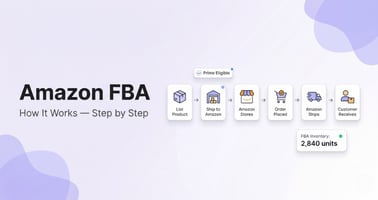
Neither method is always cheaper. Compare landed and operating cost, service level, shipping zone, returns, and volume. For background, review what Amazon FBA is.
How to Calculate Amazon FBA Fees
Calculating Amazon FBA fees requires breaking down each cost component instead of applying a single percentage to every sale. The final amount depends on factors such as marketplace, product category, selling price, dimensions, weight, storage period, inbound shipping method, returns, and optional Amazon services.
This approach helps sellers calculate Amazon fees more accurately by reviewing each charge separately and documenting the assumptions behind every estimate. After launch, compare these calculations with actual Seller Central transaction data to understand the real cost of fulfilling and selling each product.
Knowing how to calculate Amazon seller fees before launch is only half the picture — the model still has to be checked against real transactions once sales begin.
Use this sequence:
- Select the Amazon marketplace, selling plan, and correct product category.
- Enter the realized selling price after expected discounts and coupons.
- Apply the referral-fee rule for that category and price tier.
- Add FBA fulfillment based on current dimensions, weight, and product type.
- Allocate monthly storage, aged inventory, and inbound placement per unit.
- Add expected return, removal, advertising, and optional program costs.
- Recalculate after launch with actual transaction and report data.
Amazon fees are not the same as total business costs. Add COGS, duties, prep, freight, PPC, and overhead to understand profit. The Amazon COGS formula guide helps separate inventory cost from marketplace charges.
Worked Example: Amazon Fees and Real Cost on a $50 Product
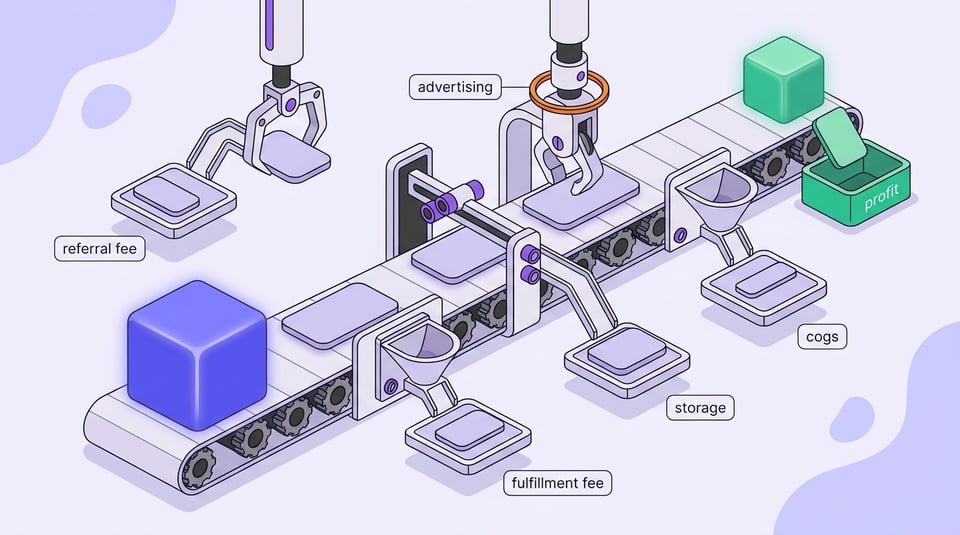
The figures below are illustrative, not an official rate quote. The assumed referral fee is 15%, and every current fee should be verified in Amazon US Fee Preview.
| Item | Illustrative amount |
|---|---|
| Selling price | $50.00 |
| Referral fee | $7.50 |
| FBA fulfillment fee | $4.75 |
| Storage | $0.25 |
| Inbound and prep | $0.60 |
| Advertising | $5.00 |
| Expected returns impact | $1.00 |
| COGS | $15.00 |
| Total costs | $34.10 |
| Estimated profit | $15.90 |
Estimated margin = $15.90 / $50.00 x 100% = 31.8%. This result is not a settlement forecast. It is a planning model that must be replaced with real fees, returns, ad spend, and COGS after sales begin.
Why Manual Fee Calculations Often Miss Hidden Costs
Manual models usually start with referral and fulfillment fees, then omit charges that occur later. Refunds, reimbursements, inventory adjustments, peak storage, aged inventory, placement, removals, PPC changes, and settlement timing can all move the final result.
Before launch, check:
- confirmed package dimensions and shipping weight;
- category and referral-fee tier;
- peak and aged-inventory exposure;
- inbound placement and freight assumptions;
- expected return and unsellable rates;
- advertising budget and margin buffer.
A good model makes assumptions visible. It does not hide uncertainty behind one precise-looking fee total.
Why Amazon Settlement Reports Do Not Match Fee Estimates
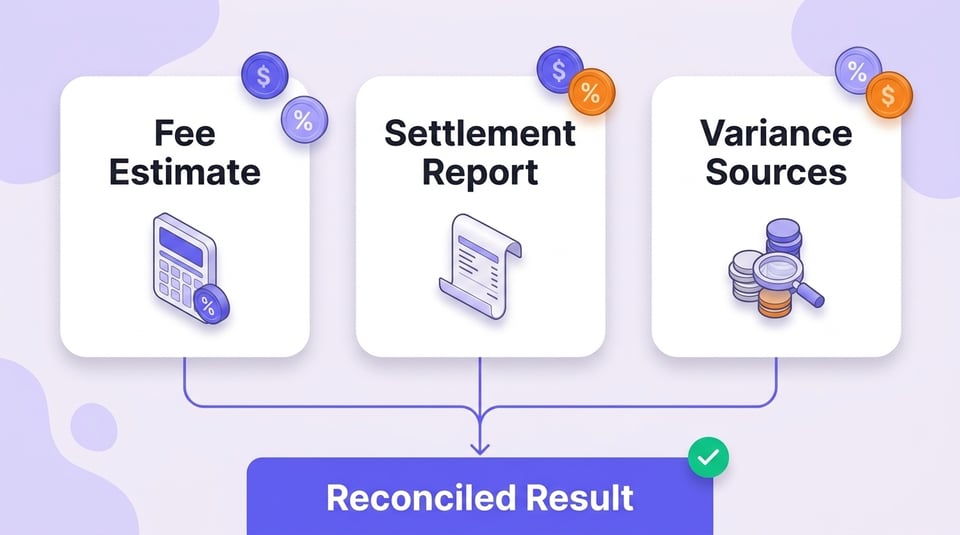
Calculators and Fee Preview estimate expected charges. Settlement and transaction reports contain actual orders, fees, refunds, reimbursements, adjustments, reserves, and timing differences. A bank deposit is therefore not expected to match gross sales line by line.
| Estimated with a calculator | Actual result | Source of variance |
|---|---|---|
| Standard referral rate | Transaction referral fee | Category, discount, refund, correction |
| Estimated fulfillment tier | Actual FBA fee | Dimensions, weight, product classification |
| Average storage | Monthly storage charge | Volume, season, inventory days |
| Expected ad spend | Actual campaign spend | CPC, conversion, budget changes |
| No adjustments | Refunds or reimbursements | Returns, claims, inventory events |
For businesses selling across channels, organizing multi-channel fees also prevents Amazon charges from being mixed with Shopify or other marketplace expenses.
How to Verify the Fees Amazon Actually Charged
Start with Seller Central's Payments dashboard. Transaction View provides detailed charges and expenses, while statements and date-range reports help reconcile activity to settlements. Use Fee Preview and FBA fee reports for product-level charges, storage and inventory reports for holding costs, Ads reports for PPC, and returns or reimbursement reports for post-sale adjustments.
A practical workflow is:
- Select one reporting period and marketplace.
- Export sales, transactions, settlements, ads, storage, returns, and reimbursements.
- Normalize dates, order IDs, SKUs, signs, and currencies.
- Match fees and refunds to products where possible.
- Add COGS and external operating costs.
- Reconcile the settlement to payout timing and investigate exceptions.
The guide to tracking sales on Amazon explains why sales, fees, and product economics should be reviewed together.
Automatically Track Amazon Seller Fees with NeonPanel
NeonPanel's Amazon accounting software can organize connected orders, referral and FBA fees, refunds, reimbursements, settlements, COGS, landed costs, and profitability in one accounting workflow. Connected data reduces repeated exports and manual categorization, while users still review mappings, missing costs, period cutoffs, and unusual transactions.
FAQ
⌃ What are Amazon seller fees?
They are plan, referral, fulfillment, storage, return, removal, advertising, and optional-program charges based on account and service choices.
⌃ How do I calculate Amazon FBA fees?
Use current category, price, dimensions, weight, storage, inbound, returns, and program assumptions. Then replace estimates with actual Seller Central transactions after launch.
⌃ How much does Amazon charge sellers?
There is no single percentage. Total cost depends on plan, category, fulfillment, product data, inventory age, marketplace, and optional services.
⌃ What is included in Amazon FBA fulfillment fees?
The per-unit fee generally covers picking, packing, shipping and handling, customer service, and the FBA returns workflow. Storage and many optional services are separate.
⌃ How are Amazon storage fees calculated?
They are based on inventory volume over time and can vary with product type, season, and inventory age. Aged inventory may create an additional surcharge.
⌃ Why do estimated fees differ from Amazon settlement reports?
Estimates use assumptions. Settlements reflect real transactions, refunds, adjustments, reimbursements, reserves, and payout timing.
⌃ Does NeonPanel automatically track Amazon seller fees?
It can organize connected fees and settlements with configured COGS and landed costs. Users still need accurate integrations, mappings, inputs, and exception review.
Fee estimates help before launch, but actual transactions and settlements should guide decisions afterward. Reconcile Amazon charges with COGS and operating costs to price, advertise, and manage inventory using real economics. Reviewing the same cost categories each month also makes fee trends easier to explain, compare, and act on before margins deteriorate.